What Real ROI from Email List Cleaning Actually Looks Like (And What Drives the Difference)
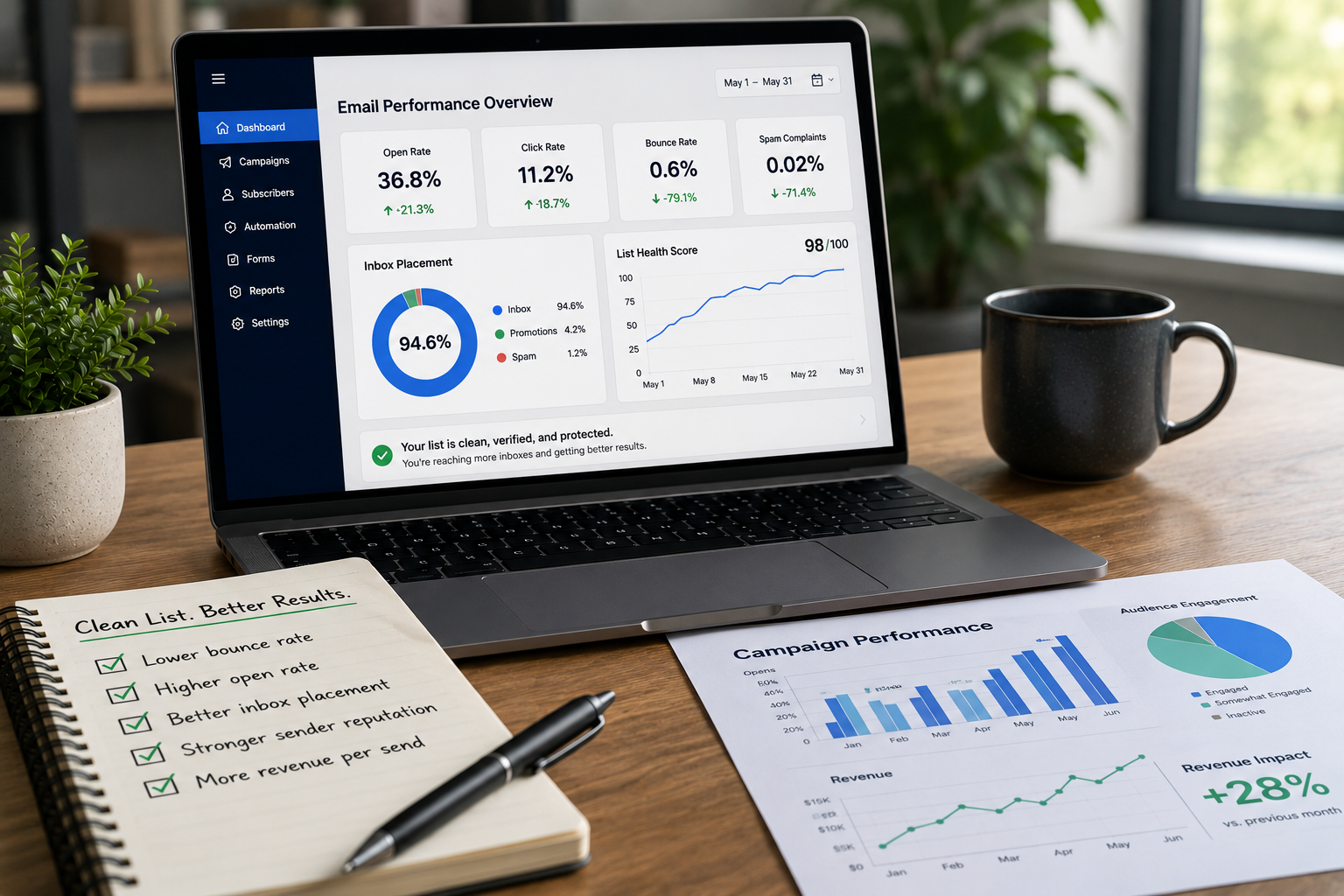
Email deliverability problems don't announce themselves with a single bad campaign. They build quietly, one bounced address and one spam complaint at a time, until your sender reputation is damaged enough that even your best subscribers stop seeing your messages. By the time most marketers notice something's wrong, the list has been dirty for months.
Email list cleaning is the process of identifying and removing invalid, inactive, fake, or high-risk addresses from your email database before they damage your sender reputation, inflate your bounce rates, or trigger spam filters. Done consistently, it's one of the highest-ROI maintenance activities in email marketing. But the results vary dramatically based on how and when you do it.
Key Takeaways
- Email list cleaning produces measurable ROI only when it addresses both existing bad data and the ongoing flow of new bad addresses entering through your forms.
- Weak results typically come from one-time cleanings without form protection. The list gets dirty again within weeks.
- Strong results combine list verification, real-time bot blocking, and engagement management in a single automated workflow.
- Realistic timelines: open rate and bounce rate improvements are often visible within the first 1-2 send cycles after cleaning; sender reputation recovery takes longer. Typically 4-8 weeks of consistent clean sending.
- Platforms like ListDefender have processed over 300 million emails and blocked 1.75 million+ bots. At that scale, patterns emerge about what actually moves the needle.
Why Does Email List Cleaning Produce Such Different Results for Different Businesses?
The short answer: most businesses treat list cleaning as a one-time event. It isn't.
Think of your email list like a water tank with a slow leak. Cleaning it once removes the contaminated water. But if you don't fix the leak, you're back to the same problem in 60 days. The leak, in this case, is every web form, lead magnet, and opt-in page that's still accepting fake signups, disposable addresses, and bot submissions without any filtering.
The businesses that see strong ROI from email list cleaning are the ones that close the leak at the same time they clean the tank.
A common scenario: a marketing manager runs a one-time list scrub before a major campaign, sees open rates jump, then watches them slowly erode over the next quarter. The campaign result was real. But temporary. Without form protection running in parallel, the list degrades at roughly the same rate it did before.
This is why the ROI question can't be answered by looking at the cleaning alone. You have to look at the whole system.
What Does Strong ROI from Email List Cleaning Actually Look Like?
Strong results share three characteristics: they're measurable, they compound over time, and they affect more than just open rates.
The most visible early signal is bounce rate. When hard bounces drop, and they typically drop fast after a thorough cleaning, inbox providers start treating your sending domain differently. The mechanism here matters: inbox providers like Gmail and Outlook use bounce rate as a proxy for sender intent. High bounce rates signal that you're either buying lists or ignoring list hygiene, both of which correlate with spam behavior. When your bounce rate drops, you're no longer being treated as a suspect sender.
Open rates follow, but they're a lagging indicator. You'll often see them improve within the first two send cycles post-cleaning, but the bigger lift comes 4-8 weeks in as your sender reputation rebuilds. Sender reputation is a score that inbox providers assign to your sending domain and IP address based on your sending history. It doesn't reset overnight.
Consider a typical case: a small business running GoHighLevel or ActiveCampaign with a list that's grown primarily through paid traffic funnels. Paid traffic attracts a higher proportion of fake and low-quality signups than organic traffic. After a full list cleaning plus real-time form protection, businesses in this situation commonly report open rate improvements of 15-30 percentage points and bounce rates dropping from problem territory (above 2%) to well under 1%. Those numbers translate directly to more revenue per send. Not because you're sending more, but because more of your messages are actually landing.
What Does Weak ROI Look Like. And What Causes It?
Weak results have a predictable pattern: a short-term spike followed by a slow return to baseline.
The root cause is almost always incomplete treatment. Cleaning the existing list without blocking new bad addresses is the most common mistake. The second most common: cleaning only the hard bounces and ignoring the subtler risks. Role-based addresses (like info@ or admin@), catch-all domains that accept everything but deliver nothing, and inactive subscribers who've stopped engaging but haven't technically bounced yet.
Inactive subscribers are the sneakiest deliverability problem. They don't cause immediate bounces, but inbox providers track engagement signals. A large segment of subscribers who never open your emails trains the algorithm to route your messages to the promotions tab or spam folder. Even for your engaged subscribers. This is the mechanism most marketers miss: your disengaged subscribers are actively suppressing deliverability for your engaged ones.
One-time list cleaning services that don't include engagement management leave this problem entirely untouched. You get cleaner data, but you don't get better deliverability. Because the engagement signal problem persists.
The Three-Layer ROI Framework: Why All-in-One Beats Point Solutions
The Three-Layer ROI Framework is a way to evaluate email list health investments across three distinct problem layers: existing data quality, incoming data quality, and ongoing engagement quality. Most point solutions address only one layer. That's why their results plateau.
Layer 1. Existing list: Verification and removal of invalid, fake, and high-risk addresses already in your database.
Layer 2. Incoming leads: Real-time form protection that blocks bots, disposable email addresses, and fake signups before they enter your CRM.
Layer 3. Engagement management: Identifying and suppressing chronically unengaged subscribers who are dragging down your sender score.
Use this framework when evaluating any list cleaning solution. If a tool only addresses Layer 1, your ROI will be real but temporary. If it addresses all three, the results compound. Each clean send cycle builds on the last.
ListDefender's full feature set is built around all three layers, which is what separates it from single-function verification tools. The ListDefender GoHighLevel integration and ActiveCampaign integration, for example, apply real-time protection at the form level. So the list cleaning work doesn't get undone by the next lead generation campaign.
How Does This Compare to Doing Nothing or Doing It Manually?
| Approach | Bounce Rate Impact | Sender Reputation | Scalability | Ongoing Protection |
|---|---|---|---|---|
| No list cleaning | Worsens over time | Degrades steadily | N/A | None |
| Manual one-time scrub | Short-term improvement | Temporary lift | Low. Labor intensive | None |
| One-time verification tool | Moderate improvement | Temporary lift | Medium | None after initial run |
| ListDefender (automated, all-in-one) | Sustained improvement | Rebuilds and holds | High. Runs automatically | Continuous at form + list level |
The table above isn't about cost. It's about the cost of the wrong choice. A list that keeps accumulating bad addresses isn't just a deliverability problem. It's a sender reputation problem that takes months to repair, and during that repair period, every campaign you send is underperforming. The revenue you're leaving on the table during that window is the real cost of inaction.
Who Gets the Most Out of Email List Cleaning. And Who Shouldn't Expect a Quick Fix?
This approach works best when your list has been active for at least 6 months, you're sending to a list larger than a few thousand contacts, and you're running any kind of paid traffic or high-volume lead generation. The more aggressive your list growth strategy, the more critical ongoing protection becomes.
It's honest to say that if you have a tiny, manually curated list of 200 people you added yourself and you know every contact, a full list cleaning platform is more than you need right now. But if you're running funnels, buying ads, or using any automated opt-in mechanism. The fake lead problem is already there, whether you've measured it or not.
What email list cleaning doesn't do: it won't fix a fundamentally broken email strategy, it won't repair a domain that's been blacklisted without additional remediation steps, and it won't improve engagement with subscribers who simply aren't interested in what you're sending. Clean data is the foundation. But it's not a substitute for relevant content and a coherent sending strategy.
You can explore ListDefender's transparent methodology if you want to understand exactly how the verification and protection layers work before committing to anything.
FAQ
How long does it take to see results after cleaning an email list? Bounce rate improvements are usually visible within the first send cycle after cleaning. Sometimes dramatically so. Open rate improvements follow within 2-4 weeks as inbox providers begin recalibrating your sender score. Full sender reputation recovery, if it was significantly damaged, typically takes 4-8 weeks of consistent clean sending.
Will cleaning my list hurt my subscriber count in a way that affects my email platform pricing? Yes, your list size will drop. And that's the point. Most email platforms charge by subscriber count, so removing bad addresses can actually lower your monthly cost while improving your results. You're paying less to reach more of the right people.
Is a one-time list cleaning enough, or do I need ongoing protection? A one-time cleaning fixes what's already there. But if your forms are still accepting fake signups and bot submissions, the list degrades again within weeks. Ongoing form protection is what makes the cleaning results last. Without it, you're treating the symptom repeatedly instead of the cause.
Can bots really be signing up to my email list that often? More often than most marketers expect. Bot activity on opt-in forms is widespread, particularly on any form that's publicly accessible or tied to a free offer. ListDefender has blocked over 1.75 million bots. That's not an edge case, that's a consistent, industry-wide problem that most platforms don't address at the form level.
Does email list cleaning help with spam complaints, or just bounces? Both. Spam complaints often come from people who signed up with a fake or mistyped address that later got reassigned, or from low-quality leads who don't remember opting in. Removing these contacts before sending reduces complaint rates, which is one of the most heavily weighted signals inbox providers use to evaluate sender trustworthiness.
What's the difference between email verification and email list cleaning? Email verification is the technical check. Confirming whether an address is formatted correctly, whether the domain exists, and whether the mailbox is active. Email list cleaning is broader: it includes verification but also covers removing role-based addresses, flagging catch-all domains, suppressing chronically unengaged contacts, and blocking risky address types. Verification is one input into a full cleaning process.
How do I know if my deliverability problems are caused by list quality versus something else? Start with your bounce rate and spam complaint rate. If your hard bounce rate is above 2% or your spam complaint rate is above 0.1% (Google's published threshold for Gmail), list quality is almost certainly a contributing factor. If your bounce rate is clean but open rates are still low, the problem may be engagement-related, inactive subscribers suppressing your inbox placement, which is a different layer of the same list health problem.
If you've read this far, you already know your list needs attention. The question is whether you want to fix it once or fix it for good. Start a 5-day risk-free trial with ListDefender and see what your list actually contains before your next campaign goes out.
About the Author
ListDefender is an email list protection platform specializing in automated list cleaning, real-time bot blocking, and sender reputation management. They work with small business owners, marketers, and CRM administrators using platforms like Keap, GoHighLevel, ActiveCampaign, ClickFunnels, and Kit to eliminate deliverability problems caused by fake leads, invalid addresses, and list decay. With over 300 million emails cleaned and 1.75 million bots blocked, ListDefender brings pattern-level insight to a problem most email platforms leave unsolved.